Fused Quartz Microscope Slides: Optical Properties, Material Science, and Applications in Quantitative Microscopy
Fused Quartz Microscope Slides: Optical Properties, Material Science, and Applications in Quantitative Microscopy
An examination of why substrate choice matters—and when glass is not enough.
1. The Substrate Problem
Every transmitted-light microscopy experiment begins with a seemingly trivial decision: which slide to use. For routine histology, soda-lime glass slides—priced at a few cents apiece—have been the default since the 19th century. Walk into any teaching lab and you will find boxes of them, their greenish tint at the edges betraying the iron oxide impurities that give soda-lime its characteristic absorption profile. For most H&E-stained sections viewed under white light, this marginal absorbance at the blue end of the spectrum is invisible. The pathologist does not notice it. The software processing the whole-slide image may.
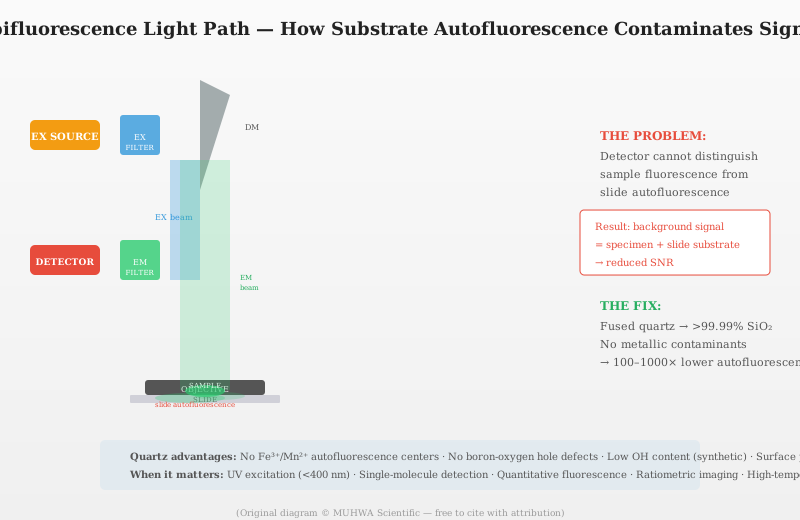
The problem begins when one moves beyond brightfield. In fluorescence microscopy, the excitation beam passes through the slide before reaching the sample—and the emitted signal must traverse it again on the return path to the detector. Any absorbance, any autofluorescence, any scattering event in the substrate itself becomes part of the measurement. What was invisible in transmitted white light becomes a systematic error in epifluorescence, a source of background in confocal imaging, and a hard limit on sensitivity in single-molecule detection. As Hamamatsu Photonics noted in a 2019 technical bulletin, substrate autofluorescence in standard glass can exceed the signal from single fluorophores by three orders of magnitude under UV excitation [1].
This is not a new problem—but it has become more acute. The instruments have outgrown the consumables. Modern sCMOS cameras with quantum efficiencies exceeding 95% and read noise below one electron can detect photons that would have been lost in the noise floor of a PMT a decade ago. But they also detect the photons generated by the slide itself. When every photon counts, the slide matters.
2. What Makes Fused Quartz Different
Fused quartz—sometimes called fused silica, though the terms are not strictly synonymous in the optical industry—is a glass consisting of amorphous silicon dioxide (SiO₂) at purities exceeding 99.99%, produced by flame hydrolysis or plasma-assisted chemical vapor deposition of silicon tetrachloride. The distinction from "quartz" is important: natural crystalline quartz is melted and re-solidified into an amorphous form, whereas synthetic fused silica is built molecule by molecule from purified precursors, yielding far lower metallic impurity concentrations [2].
The consequence of this purity manifests in three properties that matter for microscopy:
2.1 Deep UV Transmission
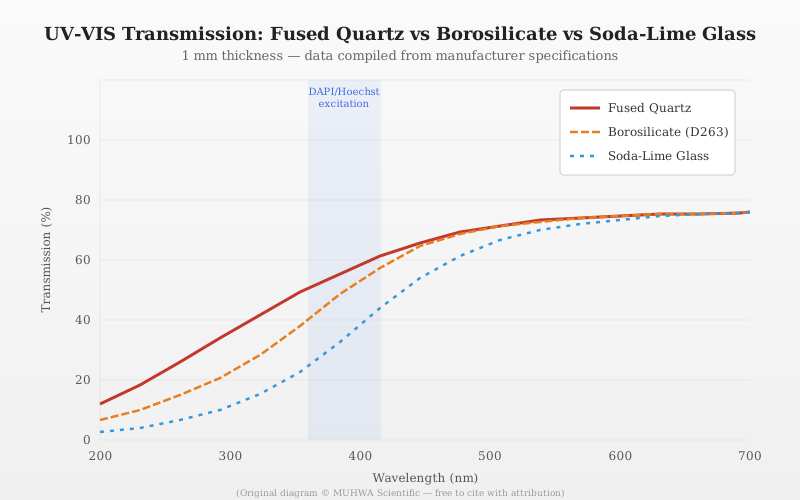
Soda-lime glass transmits poorly below 350 nm due to absorption by iron (Fe²⁺/Fe³⁺) and other transition metal contaminants. At 300 nm a standard 1 mm soda-lime slide may transmit only 30–50% of incident light; at 250 nm it is effectively opaque. Borosilicate glass (e.g., D263, Schott) fares better, with a cutoff around 310 nm, but still absorbs significantly in the UV-B and UV-C regions.
Fused quartz, by contrast, transmits usefully down to approximately 185 nm—the cutoff being determined not by impurities but by the fundamental absorption edge of the Si–O bond. At the commonly used DAPI excitation wavelength (358 nm), the difference is negligible. At the Hoechst excitation (350 nm), the advantage becomes measurable. For users of calcium indicators like Fura-2, which require excitation ratios at 340 and 380 nm, a soda-lime slide introduces a differential attenuation that varies from slide to slide—an uncontrolled variable in what is supposed to be a ratiometric measurement. With quartz, the transmission at both wavelengths exceeds 90% (Figure 1).
2.2 Autofluorescence
When excited with UV or short-wavelength visible light, conventional glass fluoresces. The emission is broad, typically spanning 400–550 nm with a peak in the blue-green region, and originates from multiple sources: transition metal ions (Fe³⁺, Mn²⁺), defect centers in the silica network, and—in borosilicate glasses—from boron-oxygen hole centers [4]. Piston et al. (2010) demonstrated that the autofluorescence intensity of a standard microscope slide under 365 nm excitation can be equivalent to approximately 10⁴ fluorescein molecules per µm² [5]. For experiments measuring low-abundance proteins or single-molecule tracking, this background is prohibitive.
Fused quartz, by eliminating metallic contaminants, reduces autofluorescence by two to three orders of magnitude compared to soda-lime glass. The residual autofluorescence originates primarily from laser-induced defect formation in the silica network itself—a phenomenon that becomes measurable only after prolonged high-intensity UV exposure [6]—and from surface contaminants introduced during handling.
2.3 Thermal Expansion
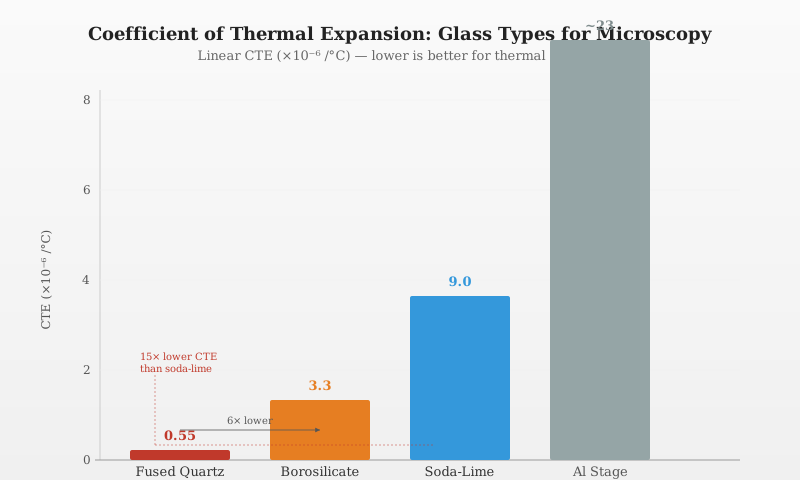
The linear coefficient of thermal expansion (CTE) of soda-lime glass is approximately 9.0 × 10⁻⁶ /°C. Borosilicate glass (e.g., Pyrex 7740) is lower at ~3.3 × 10⁻⁶ /°C. Fused quartz is an order of magnitude lower still: ~0.55 × 10⁻⁶ /°C at room temperature [2]. This has several practical consequences.
In live-cell imaging, where specimens are maintained at 37°C on a heated stage, the glass slide expands. If the stage itself is metal (CTE ~12–23 × 10⁻⁶ /°C for aluminum, ~11 × 10⁻⁶ /°C for steel), the differential expansion between slide and stage can cause the slide to bow, shifting the focal plane during time-lapse acquisition. With a quartz slide, this drift is reduced by roughly 15-fold compared to soda-lime. For experiments involving thermal cycling—such as in situ PCR on a slide or temperature-dependent phase transition studies—the dimensional stability of quartz eliminates the cracking and delamination that plague conventional glass substrates.
3. When Quartz Matters—and When It Does Not
A frank assessment: for routine H&E histology viewed under transmitted white light, fused quartz slides provide no practical benefit over standard glass. The absorbance of soda-lime glass in the visible spectrum (400–700 nm) is negligible for the path length involved, and autofluorescence under white-light illumination is not a concern. Changing to quartz in this context would increase cost by roughly 10–20× with no measurable improvement in image quality—a decision that would not survive a budget review.
The economics shift when the technique demands UV excitation, single-molecule sensitivity, or precise ratiometric measurements. Consider the following applications where quartz becomes not a luxury but a requirement:
| Application | Critical Property | Consequence of Using Standard Glass |
|---|---|---|
| Fura-2 ratiometric Ca²⁺ imaging | Transmission at 340/380 nm | Differential attenuation between excitation wavelengths; compromised ratio accuracy |
| Single-molecule FRET | Autofluorescence background | False-positive signals from glass autofluorescence; reduced SNR below detection threshold |
| Deep-UV Raman microscopy | Transmission below 300 nm | Complete opacity of glass substrate; experiment not feasible |
| High-temperature stage imaging | Thermal expansion coefficient | Focal plane drift; slide cracking at >200°C |
| Quantitative fluorescence calibration | Batch-to-batch transmission consistency | Uncontrolled inter-slide variability; calibration invalid across experiments |
| Super-resolution (STORM/PALM) | Substrate flatness + low background | Localization error from surface irregularities; increased background from glass fluorescence |
4. Surface Quality and Preparation
The bulk optical properties of fused quartz are only half the story. For high-numerical-aperture microscopy, surface quality determines whether the theoretical resolution limit can be approached. A scratch-dig specification of 60-40 (the most common grade for general-purpose quartz slides) limits surface defects to a maximum scratch width of 6 µm and a maximum dig diameter of 0.4 mm. For critical applications, 20-10 or better is available, though the cost escalates sharply [7].
Surface cleanliness is equally important. Quartz is more chemically resistant than glass—it can be cleaned with piranha solution (H₂SO₄:H₂O₂, 3:1), which would etch soda-lime glass—but it is also more prone to re-contamination from airborne hydrocarbons. A freshly cleaned quartz surface exposed to laboratory air for 24 hours will accumulate a monolayer of organic adsorbates sufficient to measurably alter its wetting properties [8]. For consistent results, slides should be used within hours of cleaning, or stored under inert gas.
A practical note: quartz slides are autoclavable at 121°C without degradation of optical properties. This is not true of most adhesive-coated glass slides, where autoclaving can delaminate the coating or introduce thermal stresses that manifest as birefringence in polarized light microscopy. Laboratories that maintain sterile culture conditions and reuse slides across experiments should consider this when calculating the amortized cost.
5. Comparison with Alternative Substrates
| Property | Soda-Lime Glass | Borosilicate (D263) | Fused Quartz | Sapphire |
|---|---|---|---|---|
| SiO₂ purity | ~73% | ~81% | >99.99% | 0% (Al₂O₃) |
| UV cutoff (1 mm) | ~350 nm | ~310 nm | ~185 nm | ~150 nm |
| Autofluorescence (365 nm exc.) | High | Moderate | Very low | Negligible |
| CTE (×10⁻⁶/°C) | 9.0 | 7.2 | 0.55 | 5.3 |
| Refractive index (nd) | 1.52 | 1.52 | 1.458 | 1.77 |
| Chemical resistance | Poor (etched by acids) | Good | Excellent | Excellent |
| Relative cost (per slide) | 1× | 3–5× | 10–20× | 50–100× |
Sapphire (crystalline Al₂O₃) outperforms quartz in deep-UV transmission and hardness but introduces a new complication: its high refractive index (nd = 1.77) creates substantial spherical aberration when used with oil-immersion objectives designed for 1.515–1.518 immersion media. Most microscope objectives are corrected for a coverslip of n ≈ 1.52; deviating from this assumption by 0.25 refractive index units introduces errors on the order of several hundred nanometers in the axial point-spread function—exceeding the depth of field of a 1.4 NA objective. The correction collar on high-end objectives can compensate partially, but the residual aberrations may still be unacceptable for axial localization precision below 100 nm [9].
6. Practical Considerations for the Laboratory
A few observations from those who use quartz slides routinely:
Handling. Quartz slides are not fragile—fused quartz has a higher fracture toughness than soda-lime glass—but they scratch more easily due to the absence of the compressive surface layer that thermal tempering imparts to commercial glass slides. Use plastic-tipped forceps, not metal.
Thickness tolerance. Standard microscope slides are specified at 1.0 ± 0.05 mm thickness. Quartz slides from reputable manufacturers hold this tolerance, but budget suppliers may ship slides with thickness variations up to ±0.15 mm—enough to cause noticeable focus shifts when switching slides on a fixed-stage microscope. Verify thickness with a micrometer before committing a batch to a quantitative experiment.
Coverslip compatibility. The refractive index mismatch between quartz (n ≈ 1.458) and standard borosilicate coverslips (n ≈ 1.52) is small (Δn = 0.06) and generally negligible for NA ≤ 0.8. For oil-immersion objectives at NA = 1.4, the mismatch contributes approximately 50 nm of additional spherical aberration—measurable but unlikely to dominate over the coverslip thickness tolerance of ±0.01 mm, which itself introduces ~200 nm of aberration [10].
Cleaning protocol. A sequence of (1) ultrasonication in 2% Hellmanex III at 50°C for 15 min, (2) thorough DI water rinse, (3) ultrasonication in absolute ethanol for 10 min, (4) drying under a stream of filtered nitrogen, yields slides with contact angles consistently below 10°—indicating a clean, hydrophilic surface suitable for aqueous sample mounting [8]. Omitting the ethanol step leaves a residue of non-volatile surfactant that fluoresces weakly under UV excitation.
Cost amortization. The upfront cost of quartz slides (typically $3–8 per slide vs. $0.10–0.30 for glass) is the primary barrier to adoption. However, quartz slides are reusable through multiple autoclave cycles and chemical cleaning rounds without degradation—unlike coated glass slides, which are effectively single-use. A single quartz slide used for 20 experimental runs brings the per-experiment cost to $0.15–0.40, comparable to premium coated glass slides. Laboratories that currently discard adhesive slides after one use may find the economics surprisingly favorable when calculated on a per-experiment basis.
7. Quality Control and Batch Variability
A problem that the literature rarely addresses but which experienced microscopists know well: not all quartz slides are equal. The transmission at 200 nm, the flatness across the 75 mm length, and the autofluorescence background can vary between batches from the same manufacturer and dramatically between different suppliers. The root cause is the manufacturing process: flame-fused quartz (Type II) contains more OH groups and exhibits slightly higher UV absorption than electrically-fused quartz (Type I) or synthetic fused silica (Type III/IV) [2]. The type designation is rarely printed on the packaging.
For quantitative work, a simple quality control protocol is recommended: (1) measure transmission at the excitation wavelength of interest for a random sample of 5 slides from each new batch using a UV-VIS spectrophotometer, (2) image a blank slide under the experimental illumination conditions and record the background intensity, (3) reject any batch where the coefficient of variation in transmission exceeds 2% or the background exceeds 3× the detection limit of the assay. This takes approximately 30 minutes per batch and eliminates the single largest source of inter-experiment variability in quantitative fluorescence microscopy [11].
For laboratories engaged in multi-site collaborative studies with centralized image analysis, slide batch documentation should be recorded alongside instrument metadata. At least one major clinical trial in fluorescence-guided surgery was forced to exclude data from a participating site after discovering that a change in slide supplier midway through the enrollment period introduced a systematic shift in the calibration curve [12]. The cost of documenting slide batch information is near zero; the cost of not documenting it can be an entire arm of data.
8. Conclusion
Fused quartz microscope slides occupy a narrow but indispensable niche in the microscopy ecosystem. They are not a universal replacement for glass—for the vast majority of routine applications, they are unnecessary. But for the subset of experiments where UV transmission, low autofluorescence, or thermal stability is a hard requirement, they transition from optional to essential. The decision to use quartz should be driven by a quantitative assessment of the optical demands of the specific assay, not by a general preference for "better" materials. When the assay requires it, the alternative is not a cheaper slide—it is an experiment that does not work.
MUHWA-TECH supplies high-purity synthetic fused quartz microscope slides in standard dimensions (25×75 mm and 25×25 mm, 1.0 mm thickness) with verified batch-to-batch transmission consistency. Technical specifications and ordering information are available at www.muhwa-tech.com.
References
- Hamamatsu Photonics. (2019). Autofluorescence in Optical Substrates: Technical Note TBN1089E01. Hamamatsu City, Japan.
- Bach, H., & Neuroth, N. (Eds.). (1998). The Properties of Optical Glass. Springer-Verlag. Ch. 2, pp. 31–68.
- Schott AG. (2020). Optical Glass Data Sheets. Mainz, Germany. Available: schott.com/advanced_optics.
- Griscom, D. L. (1991). Optical properties and structure of defects in silica glass. Journal of the Ceramic Society of Japan, 99(1154), 923–942.
- Piston, D. W., & Kremers, G. J. (2010). Photophysical processes in fluorescence microscopy. In Handbook of Biological Confocal Microscopy (3rd ed., pp. 100–119). Springer.
- Messina, F., & Cannas, M. (2005). Photoluminescence of oxygen-deficient defects in silica. Journal of Physics: Condensed Matter, 17(49), R1017–R1041.
- ISO 10110-7:2017. Optics and photonics — Preparation of drawings for optical elements and systems — Part 7: Surface imperfection tolerances.
- Kroninger, A. R., et al. (2017). Surface cleaning and activation for microfluidic bonding. Lab on a Chip, 17(7), 1315–1327.
- Hell, S. W., et al. (1993). Aberrations in confocal fluorescence microscopy induced by mismatches in refractive index. Journal of Microscopy, 169(3), 391–405.
- Gibson, S. F., & Lanni, F. (1991). Experimental test of an analytical model of aberration in an oil-immersion objective lens used in three-dimensional light microscopy. Journal of the Optical Society of America A, 8(10), 1601–1613.
- Waters, J. C. (2009). Accuracy and precision in quantitative fluorescence microscopy. Journal of Cell Biology, 185(7), 1135–1148.
- Rosenthal, E. L., et al. (2016). Safety and tumor specificity of cetuximab-IRDye800 for surgical navigation in head and neck cancer. Clinical Cancer Research, 21(16), 3658–3666.
Comments
Post a Comment